
The Forever Lot: Why Your Backyard Is the Ultimate Asset for the Next Generation
When the housing ladder loses rungs
For decades, the standard path to American adulthood followed a familiar script: graduate, land a career, save for a few years, and buy a modest starter home in a quiet neighborhood.
Today, that ladder has missing rungs. Structural inventory shortages, elevated mortgage rates, and median home prices that have far outpaced starting-wage growth have pushed entry-level homeownership out of reach for a substantial portion of the rising generation.
For adult children in their 20s and 30s, the dream of owning a home is often displaced by escalating rents that consume 35% to 50% of take-home pay. Yet while the broader housing market faces systemic gridlock, millions of long-term homeowners are sitting on an overlooked resource: permitted, titled land right outside their back door.
Building an Accessory Dwelling Unit—often called an ADU, granny flat, casita, or backyard cottage—is evolving from a casual renovation project into one of the most effective family wealth and housing preservation strategies of our era.
The economics: the starter home is in the backyard
The biggest barrier to purchasing residential property today is often the cost of the dirt. In desirable metros and suburban school districts, land value can account for 40% to 60% of a home’s total purchase price.
When you build an ADU on a lot you already own, the economics change in three important ways:
Land acquisition cost is zero. You bypass the cost of purchasing a separate residential parcel.
Capital efficiency is maximized. Every dollar spent goes toward engineering, permits, and construction, directly improving the property value rather than paying seller premiums or competitive bidding markups.
Shelter costs drop immediately. Providing an adult child or grandchild with an independent living space shields them from rent inflation, allowing them to accumulate emergency reserves, pay off student debt, or invest for their own future.
Traditional Starter Home Search | The ADU Backyard Solution |
Competitive cash offers and bidding wars | Built on land already owned |
6%–7%+ mortgage rates on a high principal | Financed via home equity or localized construction loans |
High property tax assessments and closing fees | Incremental property tax reassessment only on the ADU build |
Monthly rent lost to third-party landlords | Dollars stay within the family balance sheet |
More than equity: a three-stage life cycle
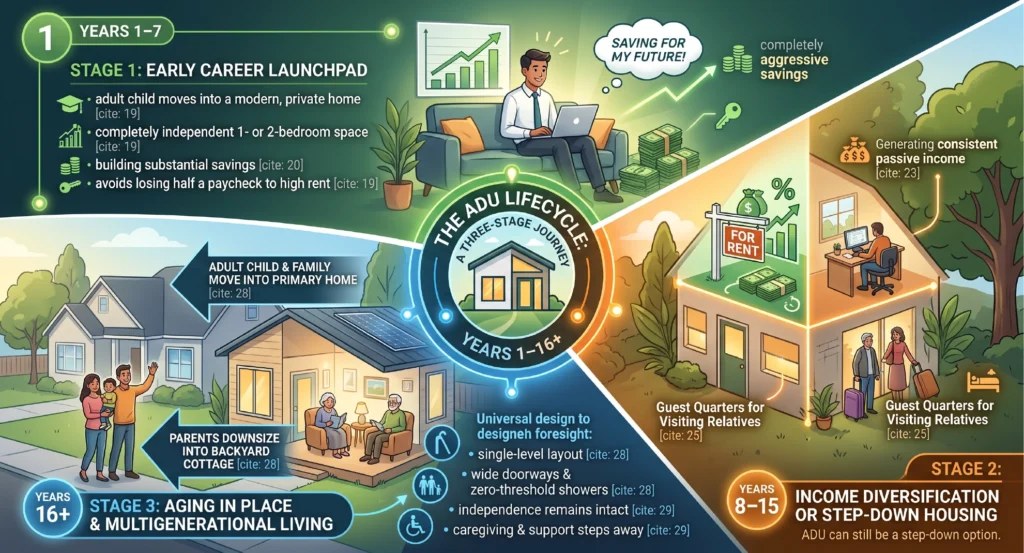
An ADU is not a single-purpose structure. When designed with foresight, it can adapt through multiple family milestones across decades.
1. The early-career launchpad · Years 1–7
An adult child finishes school or begins a career. Instead of losing half a paycheck to rent for a studio across town, they move into a completely independent, modern 1- or 2-bedroom
home in the backyard. They gain privacy and autonomy while building the ability to save aggressively.
2. Income diversification or step-down housing · Years 8–15
When children start larger families or relocate, the unit does not sit idle. Depending on local zoning, it can serve as:
A long-term rental generating consistent passive income to offset property taxes and retirement costs.
A private home office or creative studio. Guest quarters for visiting relatives.
3. Aging in place and multigenerational living · Years 16+
As homeowners advance in age, navigating a multi-story primary residence can become difficult. An ADU built on a single level with universal design features—such as zero-threshold showers, wide doorways, and flush transitions—allows parents to downsize into the backyard cottage while their adult child and growing family step into the primary home.
Independence remains intact, while caregiving and family support sit just steps away.
Editorial image suggestion: A simple floor-plan detail or interior view highlighting a single- level layout, wide doorways, and a zero-threshold shower.
Turning real estate into an heirloom
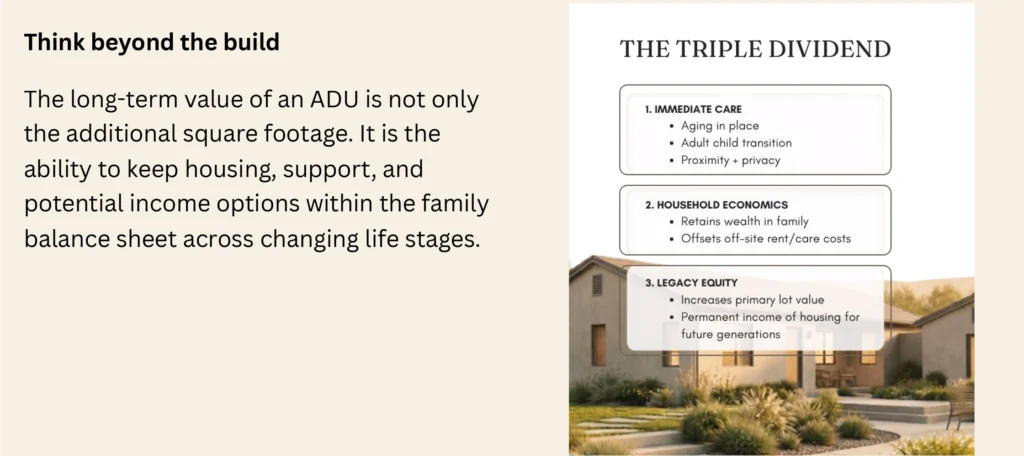
Traditional inheritance often involves dividing or selling a primary home when parents pass away. That process can trigger estate taxes, transaction fees, and displacement for the family members who might otherwise have benefited from the property.
Integrating an ADU into your property portfolio turns a single parcel into a versatile family compound. The two dwellings can provide multiple living or revenue options rather than forcing a quick liquidation in an uncertain market.
When paired with proper estate planning—such as holding the asset within a revocable living trust—the property can pass to heirs with a stepped-up cost basis. That structure can preserve flexibility across generations while clarifying how the property is intended to serve the family.
How to get started: the 4-step feasibility framework
If you are considering whether your lot can serve as a generational anchor, use this path forward:
- Check local zoning and setback requiremen Many states and municipalities have passed legislation making ADU approvals by-right, drastically reducing parking mandates and setback hurdles.
- Evaluate utility infrastructure. Determine sewer line capacity, electrical panel amperage
—often requiring an upgrade to 200A—and water access.
- Assess funding Compare options such as Home Equity Lines of Credit, or HELOCs, cash-out refinances, and dedicated renovation or ADU construction loans.
- Design for long-term fl Prioritize independent entrances, sound insulation, and single-story universal design so the space can serve toddlers, twenty-somethings, and seniors with equal comfort.
A foundation that lasts
Generational wealth is rarely about handing over a massive windfall all at once. More often, it is built through structural advantages that protect against economic volatility.
By transforming your backyard into a second dwelling, you provide your heirs with something more reliable than financial advice: a debt-resistant foundation for their future.
Frequently Asked Questions (FAQ)
Will building an ADU trigger a full reassessment of my primary home’s property taxes?
No. In most jurisdictions with pro-ADU legislation, such as California and parts of the Pacific Northwest, the tax assessor conducts a blended assessment. Your existing primary residence maintains its original tax base, and only the newly constructed square footage of the ADU is assessed at its current fair market value.
The construction will increase your overall tax bill, but it will not trigger a reset of your main home’s historical assessed value.
How much does it typically cost to build an ADU, and how is it financed?
Costs vary widely depending on whether you choose a garage conversion, prefab or modular unit, or custom ground-up build. Generally, full detached ADUs range between $150,000 and
$350,000+, depending on finishes, site grading, and utility trenching. Homeowners commonly finance construction through:
Home Equity Line of Credit, or HELOC: Taps into existing equity without replacing a low- rate primary mortgage.
Cash-out refinance: Suitable if prevailing mortgage rates align favorably with your current rate.
Specialized renovation or ADU construction loans: Underwritten based on the future completed value of the home rather than current equity.
Personal savings or family partnerships: Families can pool capital, with adult children contributing to monthly financing costs in lieu of paying outside rent.
Can an ADU be sold separately from the main house in the future?
Traditionally, no. An ADU sits on the same legal parcel and tax lot as the primary dwelling, meaning the entire property sells as a single asset.
However, several forward-looking jurisdictions have passed laws allowing ADUs to be split and sold separately under specific conditions—for example, as condominiums under California’s AB 1033. Before designing an ADU with the intention of a future standalone sale, consult local municipal planning departments and an attorney to confirm whether condo- mapping or lot splitting is legally viable in your city.
What happens if I have multiple heirs? How do we split one property fairly?
This is where intentional estate planning comes in. If one child lives in the ADU and another does not, common structures include:
Holding the property in a Revocable Living Trust: The trust outlines specific buyout mechanics, rent formulas, or first-right-of-refusal terms for siblings.
Off–setting inheritances with other assets: Retirement accounts, life insurance policies, or liquid investments can be directed to the non-resident heir to equalize the value of the shared real estate parcel.
Shared rental asset: The estate plan can require that the two dwellings operate as income-producing rental properties, with proceeds split evenly among heirs if no single heir chooses to buy out the others.
Does building an ADU require adding extra off-street parking?
In many regions, parking mandates have been eliminated or substantially reduced, particularly if your lot sits within a half-mile of public transit, is within an architecturally historic district, or is built as a conversion of existing space, such as a detached garage.
Always check local municipal codes to confirm whether tandem parking, curb cuts, or replacement spaces are required in your neighborhood.
What utility upgrades will my property need?
While ADUs tap into existing municipal water, sewer, and power services, they often require specific infrastructure modernizations:
Electrical panel: Most single-family homes with 100-amp panels need an upgrade to 200 amps to support additional heating, air conditioning, and kitchen appliances.
Sewer and water lines: The ADU will either tie directly into the primary home’s existing lateral lines or require a dedicated connection directly to the street main, depending on your city’s plumbing codes.
Separate metering: You can opt to sub-meter electric and water if you intend to track usage separately for tenant billing or cost-sharing among family members.